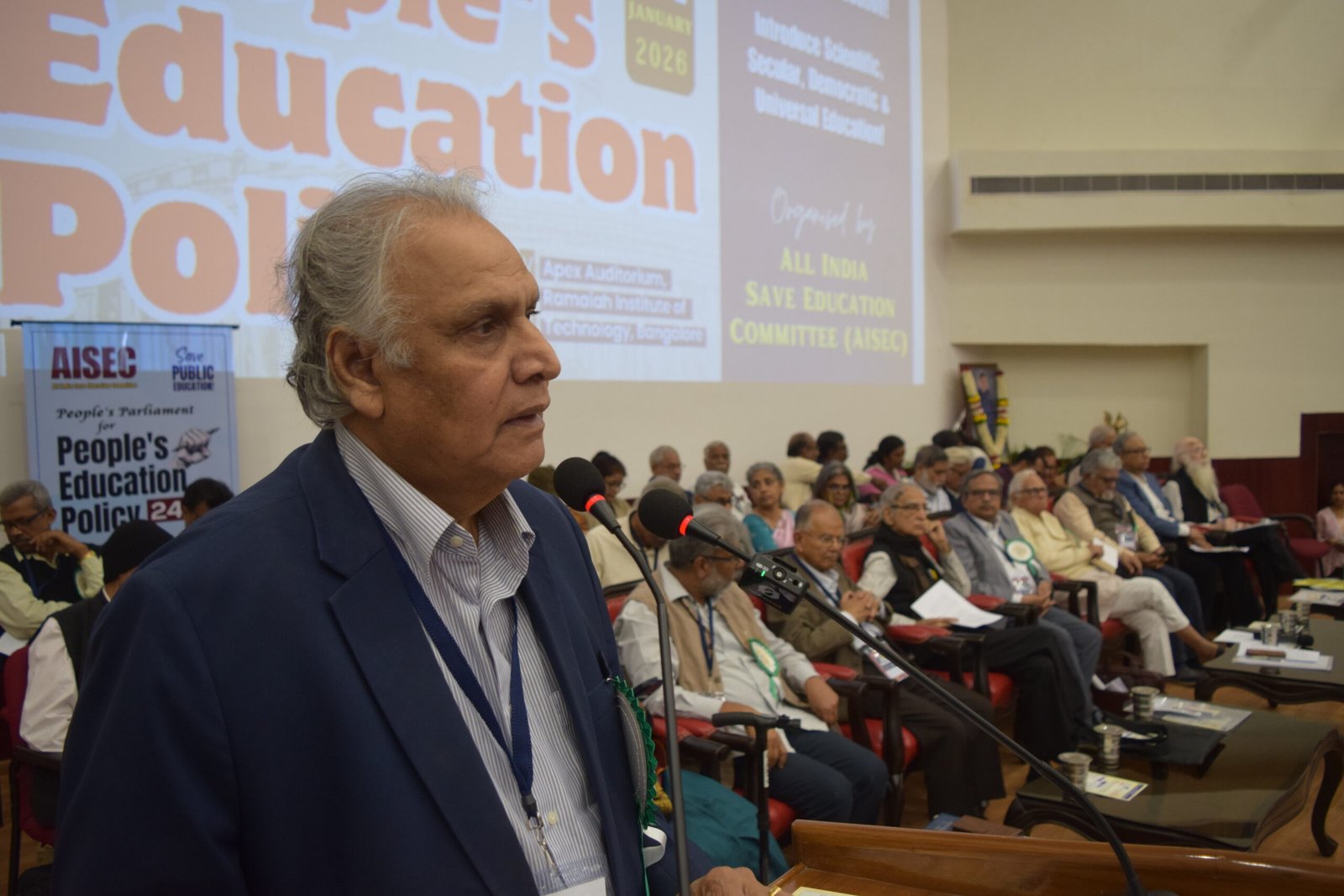
News Dated 25.01.2026 – Prof. Sukhadeo Thorat, former Chairman of the UGC, inaugurated the People’s Parliament held today at the Ramaiah Institute of Technology Apex Auditorium. The event was organized to formulate a “People’s Education Policy” as an alternative to NEP-2020.

Speaking at the event, Prof. Thorat stated, “The Central Government has implemented the NEP-2020 policy undemocratically without consulting state governments. It is moving towards complete centralization of education. In the name of the Indian Knowledge System, irrational and unscientific curricula are being designed. Since the wave of privatization in the 1990s, educational inequality has been rising. Approximately 67% of Higher educational institutions have become self-financing and private. Due to escalating fees, a 22% dropout rate is observed among the economically backward sections. Consequently, the ‘Universal Education’ has become a mirage.”He called for the adoption of a “People’s Education Policy” that is scientific, secular, democratic, and universal, treating education as a public good rather than a commodity.
Shri Jawahar Sircar, former MP and former Secretary of the Ministry of Information and Broadcasting, shared a serious warning based on his long administrative experience. He remarked that the current movement is a fight against an extremely powerful and organized force. He described NEP-2020 as a “bureaucratic tool” designed to implement four main objectives: centralization, corporatization, communalization, and privatization of education. He emphasized that this government does not respond to mere petitions and urged that NEP-2020 be challenged across all platforms, including Parliament and the Judiciary.

Prof. Ram Puniyani, well known Intellectual and retired professor from IIT Bombay, analyzed the current educational crisis. He expressed disappointment that despite being in power for 11 years, the current union government represents a century-old political ideology aimed at deepening social inequality and suppressing constitutional rights. He alleged that while quality education is being reserved for the elite, public schools are being closed, and thousands of teaching positions remain vacant.

He strongly criticized the systematic attack on scientific temper and rational thinking. He highlighted alarming changes such as the removal of the Periodic Table and the Theory of Evolution from textbooks, which shrinks established scientific foundations in favor of an unscientific “Gurukula model.” He warned, “All historical progress is built on the foundation of rational thinking; we must protect it. It is essential to fight to prevent the country from slipping into a dark age due to the attacks by the rulers.”
Earlier, Prof. Tarun Kanti Naskar, General Secretary, provided the introductory remarks regarding the People’s Education Policy drafted by AISEC. He said, “When voices were raised against the anti-education elements in NEP-2020, the question arose: why shouldn’t we create an alternative model? Accordingly, with the cooperation of several educationists across the country, a draft education policy was prepared and released for public discussion in May 2025. Lakhs of copies of this draft PEP is printed in all regional languages and circulated among the people. Discussions were held all over India in all states. Thousands of suggestions have been received. These will be discussed in this People’s Parliament to give the policy its final shape. Finally, the ‘Bangalore Declaration’ will be presented for the implementation of this policy.”
The program was presided over by Sri Prakash N. Shah, President of the All India Save Education Committee (AISEC). Prof A Murigeppa, Former VC of Hampi University welcomed the guests and the participants.

The event saw the participation of Prof. Arunakumar, Prof. Aditya Mukherjee, Dr. Niranjanaradhya V. P., Prof. A. H. Rajasab, Dr. Francis Assisi Almeida, Prof. Jawahar Nesan, Dr. Mahabaleshwar Rao, Dr. A. R. Vasavi, Dr. Shinti Antony, Prof. Allamaprabhu Bettadur, and around 1,000 delegates from various states and UTs.
Following the inaugural session, separate Thematic Sessions will be held on various aspects of the education policy. The final draft of the People’s Education Policy will be approved during the valedictory session.