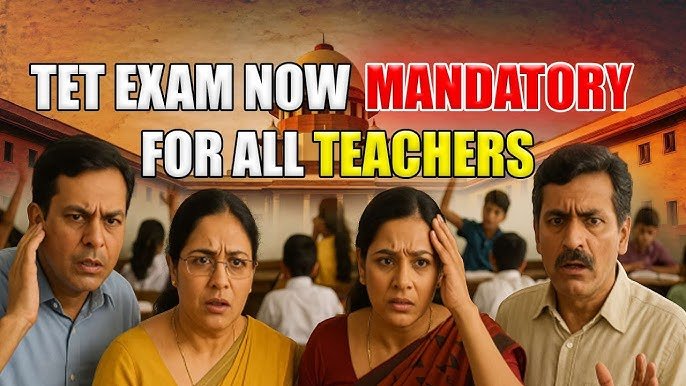
Dated 02.04.2026 – Regarding the Supreme Court Order dated September 1, 2025 on making TET compulsory for inservice teachers Prof. Tarun Kanti Naskar, General Secretary, AISEC has issued the following statement:
The Supreme Court of India in its Order dated September 1, 2025 stated inter alia:

- In-service teachers (irrespective of the length of their service) would be required to qualify the TET to continue in service.
- Those teachers who have less than five years’ service left, as on date, may continue in service till they attain the age of superannuation without qualifying the TET. However, if any such teacher (having less than five years’ service left) aspires for promotion, he will not be considered
eligible without he/she having qualified the TET. - Insofar as in-service teachers recruited prior to enactment of the RTE Act and having more than 5 years to retire on superannuation are concerned, they shall be under an obligation to qualify the TET within 2 years from date in order to continue in service. If any of such teachers fail to qualify the TET within the time that we have allowed, they shall have to quit service. They may be compulsorily retired.
Thus, Supreme Court passed an Order the effect of which will be retrospective on teachers who had joined in service prior to February 2011 when TET was introduced on the basis of RTE Act. This is totally illogical and humiliating for the senior teachers who have been serving for years. Even
Supreme Court admitted in the said Order:
We are mindful of the ground realities as well as the practical challenges. There are in-service teachers who were recruited much prior to the advent of the RTE Act and who might have put in more than two or even three decades of service.
The Order continued:
They have been imparting education to their students to the best of their ability without any serious complaint. It is not that the students who have been imparted education by the non-TET qualified teachers have not shone in life. To dislodge such teachers from service on the ground
that they have not qualified the TET would seem to be a bit harsh.
In spite of all these admissions the Apex Court issued so harsh an Order by making TET compulsory with retrospective effect. This is not acceptable. If the service of in-service lakhs of teachers is forcibly terminated it would adversely affect the public funded school education system, which is already gasping due to lack of adequate number of teachers, and pave the ground for privatisation of education. We extend our solidarity to the teachers fighting for the cause all over the country and demand of the appropriate authority at the Central Government to amend the concerned provisions of the RTE Act so that TET cannot be imposed on in-service teachers retrospectively.